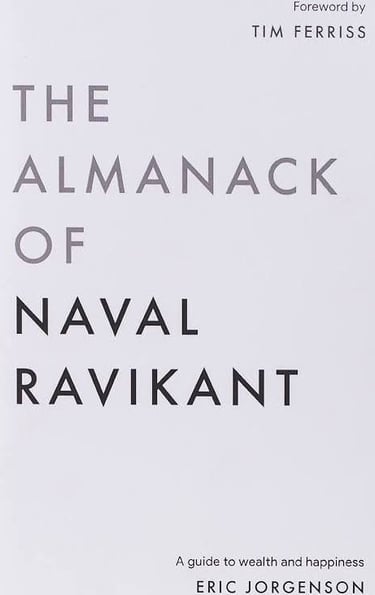
The Almanack of Naval Ravikant
Eric Jorgenson
The Almanack of Naval Ravikant is not a conventional self-help book but a curated collection of ideas, reflections, and conversations drawn from the life and thinking of entrepreneur and investor Naval Ravikant. Rather than offering rigid rules or step-by-step formulas, the book invites readers to think independently about wealth, happiness, and the nature of a well-lived life. Its strength lies in its simplicity and clarity, encouraging long-term thinking over short-term gratification.
A central theme of the book is the distinction between money and wealth. Naval presents wealth as the ability to create value while retaining freedom, rather than merely earning a salary. Skills, judgment, leverage, and ownership are emphasized as the true drivers of sustainable success. This perspective shifts focus away from competition and comparison, and toward self-development and unique contribution. The book subtly reinforces the idea that building rare and valuable skills is more powerful than chasing titles or external validation.
Equally important is the book’s focus on happiness and mental clarity. Naval argues that happiness is not something to be achieved later but a state that can be cultivated through awareness, health, and acceptance. Concepts such as meditation, reducing unnecessary desires, and learning to sit with one’s thoughts are presented not as spiritual abstractions but as practical tools for everyday life. The book suggests that peace of mind is a skill, one that improves with practice and intention.
What sets The Almanack of Naval Ravikant apart is its calm tone. There is no urgency, no pressure to “hustle,” and no glorification of burnout. Instead, the book encourages patience, self-trust, and consistency. Many of its insights are short, almost aphoristic, yet they invite repeated reflection. The reader is encouraged to pause, question assumptions, and choose paths aligned with personal values rather than societal expectations.
While the book may feel repetitive at times, this repetition reinforces its core ideas. It is not meant to be rushed or consumed in one sitting, but revisited gradually, allowing the ideas to settle and mature. The absence of rigid structure mirrors its philosophy: life does not follow a single blueprint, and neither does growth.
In essence, The Almanack of Naval Ravikant serves as a guide for those seeking clarity in an increasingly noisy world. It does not promise instant success, but it offers something more enduring: a framework for thinking clearly, living deliberately, and building a life grounded in freedom, learning, and inner stability.